
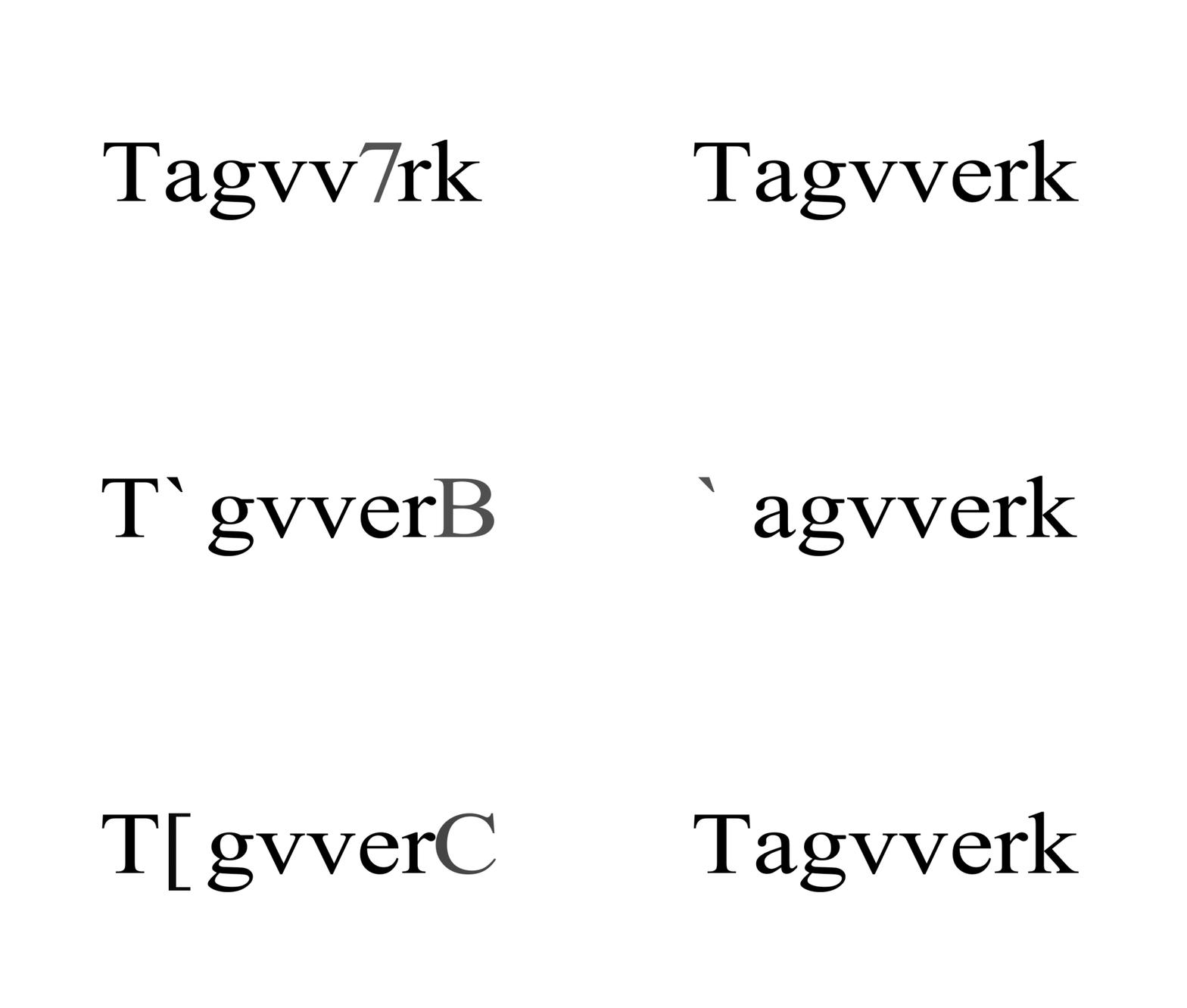

One True One of Anything (Green)
Peeled paint fragments on 4′ x 8′ plywood, installed on Dekalb Ave construction site, Brooklyn NY, August 2023.
Douglas Rogerson
For you—

I’m at Julius’s again just thinking out quiet here for a minute not really trying to do a poem after all. I am thinking how to write to you, how to tell about yr work in a way that matters, which is really to say how to tell you about us, me and you, our whole history and why should that love letter matter to anyone outside of it. Other writers I love seem to do it so easy. Other people I mean who are people but also who write about not just things I love but in a way that makes me feel like maybe I could love them too—the people and the subjects both I mean. So what if we are each other’s subjects. Gwendolyn Brooks she already said it best when she said: “we are each other’s / harvest: / we are each other’s / business: / we are each other’s / magnitude and bond.”1 There oughta be a closer word than business though I think, something less transactional. What I mean is, whoever else is reading this, I don’t maybe know you, not yet, and here I have an opportunity to invite you into such a love. Asking you kiss the next can you kick down the street.
This place used to be a place.
1 From Gwendolyn Brooks’ poem, “Paul Robeson,” first published in 1970. That’s 22 years before I was born. Easily 50 years before I ever really knew what she meant. Before I really felt it for myself.


One True One of Anything (Green), detail.

Every day the concrete blooms. The ruins in progress blossom, flower, shed their rubble in the morning. Scaffolding sprouts along the walk stealing the sun from the trees. Blue tarp billows out the flameblasted windows and birds are chirping somewhere near but there’s not a taste of green in sight. These are transitory lands, wandering lands. Graffiti tags like area codes tattooed across town, constantly re-zoning the neighborhood. For years the laundromat on the corner said simply “STEVE” in big green letters. Then one day that awful off-white come to cover it up. Now it says “TE AMO JUAN” in pink, big heart around it all. I love you Juan. I miss you Steve. More men I’ll never get to know.
It’s too many men I only know like this—by the suggestions their names leave behind. Each boarded up school or half-begun residential casts its shadow of Times Square, of the Chelsea Piers, the People’s Beach, the Old City, of the screens in my hand and the capital letters in my veins. The letters weather me away. Each morning I swallow the men come to patch my repairs—they come in hardhats, heavy boots, bright electric vests, their skin is dark and gentle. They caulk the leaky corners, re-bolster the baseboards. They are doing the best that they can. It’s always something new in this old house. They come and they go and they will be back again tomorrow and the next day until I can no longer afford the repairs. Maybe then I’ll go back down to my materials, make shelter for others to come in from the cold. Until then, I walk me out into the rain and snow, let the old wheel inside the wheel keep its pace.2 Do you still let the land take you like this too. If I was where I would be, when I get there will you show me what you see. All those photos from yr roll on my wall, in their frames. There’s nobody in the shot but all I can see is us.
2 Lyrics from the final track on Gillian Welch’s 2001 record, Time (the Revelator), “I Dream A Highway.” Spent half my life with you on dark highways, overgrown backroads, at the feet of steep cul-de-sac driveways. Neither of us have cars anymore. Let this letter be a highway back to you.


Images from Dekalb Ave construction site, Brooklyn NY, August 2022.

There was a place not so far away from here that could have been a place. Big empty lot between two houses, not even a patch of grass just wet dirt and metal pieces strewn through. People could be doing a life there. Making a casserole. Watching TV. Camping in the field out back with the spiders and the moon. Fucking each other gentle and kind in the privacy of their own consent. Now the place is stuck in possibility. Sticky with potential. And I am furious about all the joy that should be happening here instead. The only green here coating the wooden slabs to keep the future out. Wood struck down and splintered, pulverized, re-made in its own image. Sometimes the paint peels back and I think: Good. I see you. Staples where the POST NO BILLS flyers would be. Splinters on the walk. I’d bring them all back home if I could. But a home it comes with you follows you Home.
On the way to yr place one day, another tattoo tag this time: REAL LOVE IS QUEER RAGE. One foot across the sea you are building yr own green, and I am on yr floor again where I’ve always felt the safest. I was probably playing the music, blues on the ceiling as usual.3
–Where are you gonna put it.
–Just down the street, you know the place.
–Do you need help.
–I think I need to do it myself.
3 First time I heard a Karen Dalton rendition of “Blues on the Ceiling” was on her 1969 debut studio recording, It’s So Hard To Tell Who’s Going To Love You The Best. “I’ll never get out of these blues alive,” she sang. AIDS took her in March of ‘93, just a few months before you were born. I’d barely been around for a year before she left. You take my blue, I’ll keep yr green. Without you I wouldn’t be.

REAL LOVE IS Queer RAGE, graffiti tag, Dekalb Ave construction site, Brooklyn NY, August 2022. Artist/author unknown (speculatively a contributor to the ACT UP group Queer Nation).
Now I see green different. And those deli bags, the ones with the purple roses I used to save for you. The sunbleached blue of a plastic mesh fence. Taped up mattresses on the walk. All the scattered, discarded, precious debris. I can hardly bear it. Our version of carving initials into the tree, you and me. And you too, whoever you are, whoever put those words there. I wonder did you leave this here for me to find. Well I’ve found it. And so I leave this here for you. Are you even reading this. I wrote it all for you, after all. And we have to find each other too just like this. How we’ve always found each other, in the shadows of our capital letters.


One True One of Anything (Green)
Peeled paint fragments on 4′ x 8′ plywood, installed on Dekalb Ave construction site, Brooklyn NY, August 2023.
Douglas Rogerson
**
DOUGLAS ROGERSON grew up in Knoxville, TN and studied a combination of physics, philosophy, and art at Washington University in St. Louis. He subsequently received a fellowship at Akademie Schloss Solitude in Stuttgart, Germany under the disciplines of Visual Art and Humanities before joining Brooklyn’s fabrication industry for several years. His work has been installed in domestic and streetside settings, published in Schlosspost’s Gemini — The Journal, The Solitude Blog, and Issue 03 of Passing Notes, as well as exhibited at Herbert Von King Cultural Arts Center and Weatherproof’s “The Hole” (forthcoming, Dec 2023). He is currently pursuing his MFA at Glasgow School of Art.
CEA / (CONSTANTINE JONES) is an interdisciplinary Greek-American thingmaker raised in Tennessee & housed in Brooklyn. They are the director of the Visual AIDS Oral History Project, THE BODY AS AN ARCHIVE, as well as a member of the collective, What Would An HIV Doula Do?. They are the author of the novel, IN STILL ROOMS (Operating System, 2020) & a collaborative chapbook with Portuguese visual artist Vicente Sampaio, BALEEN: A POEM IN TWELVE DAYS (Ursus Americanus, 2022). Their work has been performed or exhibited across NYC & Tennessee.

