Jared Joseph


The Body Politic on Fire


The media effort to neutralize Aaron Bushnell’s act of self-immolation in protest against US complicity in and funding for Israel’s siege on Gaza is well under way. It is taking the all-too-familiar turn of isolating his action through diagnosing it as the symptom of a troubled youth with a troubled past; that his self-sacrifice had nothing to do with our country and the state of the world, and everything to do with his mental health and his religious upbringing; that, as a senior active member of the US Air Force which explicitly champions the sacrifice its military members make for their country, Bushnell’s sacrifice does not count as such, and is instead pathological, the work of an “anarchist.” The American media diagnosis of Bushnell as an anarchist with a religious past reveals itself as, ironically and substantially, a national self-diagnosis of a state that produces mental health crises in its citizens, that does not provide adequate or comprehensive care for those with mental health issues, and that for example allows a former president, one who fomented an anarchic uprising amongst members of the extreme Christian right in order to storm the Capitol to overturn the results of a democratic election, to run for president again. To call Aaron Bushnell sick is to betray the sicknesses beleaguering our democracy. While recognizing and honoring the agency Aaron Bushnell employed on Sunday as a choice of self-sacrifice for his country, I also aver that it is this country that has martyred him.


The extremity of Bushnell’s action is a reaction to the extremity of the context; Bushnell was explicit about this in his video of his self-immolation:


My name is Aaron Bushnell. I’m an active duty member of the United States Air Force. And I will no longer be complicit in genocide. I’m about to engage in an extreme act of protest, but compared to what people have been experiencing in Palestine at the hands of their colonizers, it’s not extreme at all. This is what our ruling class has decided will be normal.


Bushnell identifies himself as part of an American military force that has aided and abetted and armed the Israeli occupation for decades; he speaks in its name, he ascribes to himself accountability for his having served in its name, and he marks this moment as a discontinuance of that complicity. What he is about to do is extreme, but it’s marginal in comparison to what “our ruling class has decided will be normal.” His self-immolation is horrifying, but it is child’s play in comparison to how our country is actively aiding Israel to immolate the so-far 30,000 men, women, and children of Gaza which it has colonized. That it is “our” ruling class, Bushnell’s, mine, and yours, means we cannot disavow him from our community. And if our ruling class has “decided” that the extreme will be normal, then Bushnell exposes the horror of this normalization, of normalizing systematic and widespread military death, by turning it upon himself. In this way Bushnell takes measures to give context to his actions.


There is a reason Bushnell goes to such great lengths to control his narrative; it is because Western media consistently suppresses the facts on the ground to construct a narrative that supports Israel. Western news articles call it a “war” between Hamas and Israel in order to create a narrative of parity, but Hamas is not a state, and the vast majority of casualties in this “war” are Palestinian civilians. When western news outlets report the number of these Palestinian deaths, it is almost always affixed to “according to the Gaza Health Ministry,” undermining the tragedy. When it comes to reporting Israeli deaths on October 7th committed by Hamas, however, the number 1,200 is reported without any qualifier. It is presented as objective fact, despite Israel having originally reported that 1,400 people were killed, and major news outlets at the time, including The New York Times, having accepted the number without subjecting it to scrutiny. The Oct. 7th attack is characterized as a “surprise attack,” which is a surprising characterization when a territory has been brutally denied sovereignty for 75 years, and when Gaza has specifically had its food, drinking water, and power blockaded by Israel for 15 years, creating conditions that the UN has described as “unlivable” since 2020. News outlets call Israel’s siege an ”invasion” of Gaza, but it is not an “invasion” if Gaza has been occupied by Israel since 1967, and blockaded since 2007. On the other hand, news stories continually invoke Israel’s “right to self-defense,” but never Palestinians’ right to life in the first place. One almost never hears testimony from Gazans because of the frequent power outages and targetings of communications towers, because of their ceaseless slaughter, because Israel prohibits journalists’ entry into Gaza, and because of Israel’s intentional murder of journalists: as of February 28th, the Committee to Protect Journalists confirms 94 journalists and media workers dead, 89 of which are Palestinian.


Not that this is anything new, or a “surprise attack” from western media: the citizens of the western world have been kept in the dark for a long time about “post”-colonialist projects supported by the United States. June Jordan’s poem “Apologies to All the People in Lebanon” – which refers more specifically to the US-backed Israeli invasion of Lebanon to rout out the Palestinian Liberation Organization in 1982 – is nonetheless “Dedicated to the 600,000 Palestinian men, women, and children who lived in Lebanon from 1948-1983.” 1948 refers to the Nakba, or “Catastrophe,” the violent expulsion of 750,000 Palestinians from their home by the newly Western-minted colonizers Israel; many of them fled to Lebanon. The poem begins on what soon becomes a chorus:


I didn’t know and nobody told me and what
could I do or say, anyway?


And then continues with a litany of what “They said,” i.e. what Israel and Western powers reported in the media to justify their actions, followed by the revelation that this narrative turned out to be untrue:


They said you shot the London Ambassador
and when that wasn’t true
they said so
what
They said you shelled their northern villages
and when U.N. forces reported that was not true
because your side of the cease-fire was holding
since more than a year before
they said so
what


The use of the past tense denotes a history, an alternative history that encompasses within itself the way western powers narrativized that history, in order to “make history” the way they wanted to. And this is the thing about having power: when someone points out to “our ruling class” that they lied, the “ruling class” has the power to respond “so what.” This is essentially what Joe Biden did on February 27th, when he expressed to reporters blithe unconcern and unawareness as to when a ceasefire might take effect, while eating an ice cream cone. The blitheness of these leaders, throughout time, leads to brutal culminations of these endlessly cyclical histories:


They said something about never again and then
they made close to one million human beings homeless
in less than three weeks and they killed or maimed
40,000 of your men and your women and your children

But I didn’t know and nobody told me and what
could I do or say, anyway?

They said they were victims. They said you were
Arabs.
They calledyour apartments and gardensguerrilla
strongholds.

They calledthe screaming devastation
that they createdthe rubble.
Then they told you to leave, didn’t they?


“Never again” is happening again, here and now in 2024 – the likening of the Palestinians to the Nazis and the Israelis to the victims, authorizing a narrative of persecution in order to legitimize creating devastation, creating “rubble.” Israel now calls Palestinian hospitals “strongholds,” and has destroyed nearly every one of them. Those people inside, and outside, hospitals that Israel kills, it calls “human shields.”


Why is “never again” happening again, almost exactly as June Jordan describes it, with almost the exact same western media strategies of distortion and obfuscation? To some extent the question is the answer: we are inundated with these horrors about which we are not told, but only shown. There are few titles or captions Western Media will permit which say “US serviceman dies after setting himself on fire in Gaza protest” (Al Jazeera). Instead we have titles like “Airman who set self on fire grew up on religious compound, had anarchist past” (The Washington Post). In other words, “But I didn’t know and nobody told me.”


On the other hand, the poem, again, is written in the past tense: “I didn’t know” means “I know now.” Knowing these things about what our country does without telling us – without receiving our democratic consent – and where 15 billion dollars of our tax dollars is set to go produces more than just a deep-seated sense of powerlessness.


But I am not an evil person
The people of my country aren't so bad

You can expect but so much
from those of us who have to pay taxes and watch
American TV

You see my point;

I’m sorry.
I really am sorry.


The degree of helplessness and despair; the regularity of the news cycle and its precise, almost subliminal hold on narratives that bolster the western ruling class; Twitter and Meta platforming pro-Israeli views and decreasing pro-Palestinian ones through their algorithms, or the newspaper, or American TV; living in a time of such extreme efforts by western media to hide from us what’s happening and simultaneously immiserate us through funding foreign and colonizing investments; it’s no wonder, then, that there would be such extreme attempts to broadcast, or to be, something different on the news cycle.


Why have I spent so much of this essay focusing on a poem? Because ultimately I am writing about the human experience, and what it is like to live in a time where not only is so much of reality mediated to turn into a spectacle we can’t participate in, but also where the reported spectacle so keenly and so harrowingly does not match the reality of the spectacle. This morning, like most mornings, I was listening to NPR, and the story was diving into the depths of how the Gaza Health Ministry reports its casualties. While, as I outlined above, most western media outlets insinuate or outright state that the Gaza Health Ministry inflates its death toll, in a rare turn NPR was describing how the death toll is actually far lower than reported, since the Gaza Health Ministry only records deaths from direct Israeli military fire. This is 30,000 people, said NPR, and primarily women and children. What NPR meant by “primarily women and children” was civilians, since western media does not consider Arab men to be civilians. The count does not include in it those tens of thousands trapped under rubble, said NPR, and it does not count those killed by disease, starvation, and thirst, from which the entire population of 1.9 million is direly suffering. NPR reported that the few Palestinian witnesses they were able to speak to in the recent past have by now all been killed, including one woman and 22 members of her family.


What is to be done about this? I live in Los Angeles, where there are on average 2 or 3 pro-Palestine protest actions per week, including huge marches shutting down major downtown thoroughfares, disruptions of fundraising dinners for the military, Free Palestine stickers and tags all over the streets, vigils at City Hall. In Washington DC thousands have flooded the National Mall, in Oakland protesters have chained themselves to weapons-carrying cargo ships, in New York City protesters gather outside The New York Times headquarters to expose its Israel-biased reporting, they’ve created a parody newspaper called The New York Crimes. We have Writers Against the War on Gaza (WAWOG), the Palestinian Youth Movement, Jewish Voices for Peace, If Not Now, Labor for Palestine, Healthcare Workers For Palestine, Palestinian Feminist Collective, Purple Up for Palestine, Queers for Palestine, Film Workers for Palestine, and hundreds more coalitions of people of all backgrounds all over the country coordinating actions to spread awareness and break through the media blockade. Not once have I heard mention of any of these groups or disruptions or actions on NPR, in The New York Times, in The Guardian, in any of the major western media outlets. It is not only disgusting, it is not only sickening, but it is bewildering to see how entrenched corporate and governmental institutions (and in an age of highly developed neoliberalism, the corporate and the governmental are effectively the same) are in their opposition to their constituents/consumers. It’s a desperate situation, because the situation “will not be televised.”


Which brings us back to Aaron Bushnell. Bushnell is being compared to a number of antecedent acts of self-immolation, but it’s noteworthy that the farthest back is relatively recent: the Buddhist monk Thích Quảng Đức, who self-immolated in 1963 to protest anti-Buddhist discrimination by the government of South Vietnam, which was, like Israel, backed by the US. Similarly, the Arab Spring was sparked by Mohamed Bouazizi’s act of self-immolation in Tunisia in 2010, which caused revolutions and toppled governments all over the Arab world. Of course there are many more historic acts than these two, but I highlight them because their performances were coincident with the emergences of new kinds of media. Both instances were not only aided by media – TV had just emerged as the dominant media in the 60s, and social media like Twitter and Facebook were essential in the case of Tunisia – but self-immolation as a practice seems almost designed for media. It’s an act of desperation but also of calculation, when systemic social conditions are so bad that the common “what could I do or say, anyway?” is replaced by an act of self-sacrifice that exposes the intensity of those very conditions, and attempts to persuade society to reckon with them. The image and the fact of the act of self-immolation is meant to spread rapidly and consume everything in its spread – to break through and turn to ash the news-as-usual cycle – like wildfire.


In this essay my purpose is not to take a stand on whether Aaron Bushnell is a hero or, as major western news outlets are characterizing him, an anarchist, a religious fundamentalist, someone suffering from a mental health crisis, etc. My point, instead, is to focus on why so many major western news outlets assay to portray him in precisely these ways, and why so many of these articles end by providing the phone number to the Suicide & Crisis Lifeline. I think it is because in their effort to neutralize him by isolating him through character defamation – and saying that someone suffering from a mental health crisis is not to be believed is, frankly, disgusting – simultaneously operates as a confession of guilt on the part of the western ruling class, as a communal psychological projection which turns around and betrays a sociological self-diagnosis. To accuse Bushnell of anarchy is to admit that democracy is not functioning in our society. To accuse Bushnell of religious fundamentalism is to admit that the Christian Zionist lobby has elevated support for Israel beyond the reach of public consent. To accuse Bushnell of suffering from a mental health crisis is to admit that our society does not permit, preserve, nor safeguard public health and sanity. To attempt to suppress the political context of Bushnell’s action – an end to US complicity in Israel’s siege of Gaza, and advocating for a free Palestine – is to admit that if Palestine is not free, none of us are free.


**

JARED JOSEPH attended the Iowa Writers’ Workshop and now lives in Los Angeles and teaches at Los Angeles City College. Recent work has been published in The Brooklyn Rail, the Los Angeles Review of Books, and Gulf Coast. A Book About Myself Called Hell was published with Kernpunkt Press in February 2022, and a novel, Danny The Ambulance, was published by Outpost 19 in September 2023.

Doug Nufer


Like Kafka Was the Rage


1

Her own avant-garde, a slow dance, a parody of classical poses, a preview of things to come, an invention that was not quite perfected, a forerunner or harbinger, a new disease, the driver of a locomotive, the next step for me, my future, my fate, a form of shabbiness, literature, a stimulant, an aphrodisiac, my new paradise, her most secret part, a piston, Paul Klee’s Twittering Machine, the opposite of premature ejaculation, simultaneous translation, an invitation into that life, an uninteresting quarrel with the real, she went in for metaphors, like a work of art, like a split personality or two schools of thought, like a woman stepping out of a heavy garment, like a bird pecking at things on the ground and then arching its neck to swallow them, like a great black animal, a bear or a buffalo, like an illness, like a great smile in its sullen history, like a breach of contract or a criticism, like sand, like camping, a kind of exhibitionism, like a man running out of a burning building, like a woman dancing, as if composing a fugue, like one of those modern black jazz singers who works against the melody and ignores the natural line ends, like a collapsing of structures, like a building falling down, a sort of asking and answering of questions, like semantic despair, like a dog that you tie to the parking meter, like liberal politics, like two people walking through a gallery.


2

Like a luxury postwar romance, like exiles in our own country, our studio, as if it were a concentration camp, the way you go to a party, like a judge in criminal court, a blind date with culture, like testifying dueling scars, a brooding hen, the storm trooper of humanism.


3

A serial monogamist, like a policeman who doesn’t drink or sit down while on duty as a critic like a lecturer or a peripatetic philosopher, like someone helping to park a car, a seminar, like punching literature in the mouth, like the final orchestral cadences of a classical symphony, a kind of book as an El Greco portrait of a cardinal or pope, like Christ’s in a twelfth-century painted wooden crucifixion, like a priest of the Inquisition, like a man being persecuted as if he was trying on gloves, like an exquisite dog, a quattrocento Madonna like a flower.


4

The vacuum of my imagination, like hunchbacks living off the land or sailing around the world, the family I wanted as characters, like meeting old friends or lovers, like dolls or teddy bears or family portraits, like a surprising number of uncles as dreams that seem so unbearably actual, like someone buying a dog like Saint Jerome in his study bent over his books with the tamed lion of his conquered restlessness at his feet, like people reading the names on a war memorial, a place of last resort, a kind of moral flophouse.


5

The ghost of her younger self, like the guitars in cubist paintings, like a Japanese actress, as Chinese women used to deform their feet, like someone who really doesn’t want to buy a book browsing in a bookshop, like someone at a party, like someone in a dream the morning after the party.


6

I’ve never known anyone who used so many figures of speech, like living in a foreign city like a native, like when I used to read Surrealist poetry in French, like the women you see being abducted in romantic paintings, like bad rock music, more like a Chopin etude, a desultory or absentminded strumming as the velvet bleeding-heart medals, like a burglar, like a killer as a rocket, a poor piece of plumbing, a sleepcrawler.


7

Like having to take the subway, a counter invasion, like humidity or smoke, a German Marshall plan, as if we had been unconscious, like an immigrant who goes from a poor country to a rich one, a bad dream, like a shadow on my happiness, like static in my head, like the sound that billions of insects make in the tropics at night private treaties with ourselves, unconditional surrender from life or to it, the black market of personality, a whispering in my molecules, as remote as grinding your teeth in your sleep, the complaint of cheap apartments as if my brain had something stuck in its teeth, like Lorca’s “pain of kitchens” like someone lying in bed or a field of grass as if he heard a fly buzzing the sound of my converter, like the path they are supposed to take, like playing a game of tag or blindman’s bluff, like the Sunday Times, like a high jumper poised for his run, as if I had grabbed him by the lapels, like someone who sneezes into a handkerchief and finds it full of blood, a first draft, like flying, like the death instinct, a poetics, as if we were two literary critics discussing a novel.


8

Screams in their eyes, like the screams you hear in movies, a blue note like a factory whistle, like the girl in the Munch painting as if she was gargling a diphthong like an alarm clock, a riddle or conundrum.


9

Like church services, more or less a lie, the truth about life as students would go to India, as if he was whispering or hissing sexuality, promise or threat, like a man praising a woman’s beauty to her, a penalty you had to pay, like the German translators taking the puns out of Shakespeare, like a fate, angel of scholarship, a martyr, a medieval cantor or Gregorian monk praying in color like walking into a park like a theater searchlight on the world like fire, like a chiropractor cracking the bones at the base of your neck like a wild goose.


10

Yoga mime isometrics, like a person who is about to go abroad for the first time, like lovers in a sad futuristic novel, a place where all sorts of expectations and illusions come to die, a flight from art like one drowned person resuscitating the other, a foyer to madness like space, a little picnic of madness like an escaped balloon, like a tenement that had been partially demolished by a wrecking ball like orgasm, a shudder of hypotheses, like a man chasing his hat in a high wind having a permanent erection as if we were in a race, like interlocking initials dream like the people in medieval paintings, an investigation of loneliness safari, as if our love was a stove and she was letting all our gas run out.


11

Like people looking for love, like a character in one of those novels reviewers describe as shuttling back and forth in time by a young novelist who had been influenced by Kafka lyrics of a blues song splitting of the atom, as if I had butted against a glass door as a bird on a perch like the glare of truth caught in the high beams as if it was to be our last look, as if she were a blueprint meant to be sold by Floradora girls, as if he was diving like a dog, as if they’d burst the whole world upside down like a gymnast monstrous spider scuttling across the ground.


12

A fool’s errand the morning after the war as if a great bomb, an explosion of consciousness had gone off on American life, a great hangover, like a recurrent temptation to commit a crime like a painting by Magritte like a patient in a hospital recovering like a negative of a rainbow door swinging on its hinges in a draft turning a wheel like a pitcher shaking off a catcher’s sign like dying like an Irishman in a book, a failed lawyer or a defrocked priest like a witness on the stand who can’t remember.


13

Like a rooster crowing from a more advanced planet like an exclamation, as if he had talked his hair off, always Halloween on an intellectual bender, as if Brooklyn had been preserved in a refrigerator for my jungle, my Africa, as if he was taking notes to concentrate on walking like a shooting pain.


14

As if he couldn’t bear to look at it directly as vaudeville, as if blinded by reading like birds, a flight of chairs like a box seat as if they were mating on the wing like the Parisian apache dancers, a dancer who has one leg shorter than the other citizen only of literature, like postponing orgasm like a society with no failures like someone trying to force his way across a dance floor as if he was trying to imagine another culture as you sometimes hunger for a Mexican dinner that will burn your mouth, like those life preservers that expand when you pull the cord taking a dance lesson.


15

As if she was pulling it off or hiding behind it like a Little Orphan Annie who had been kidnapped by art, as if they had thrown up a picket fence to protect him like an inflatable toy that had been overinflated in a bad pub with the wrong people, like an Ibsen heroine perfect enjambment in a poem.


16

Like a parade like Dr. Caligari in the movie as if he had adopted the European walk of his favorite writer, like a dog shaking off drops of water as you love the poems and stories you can’t write like a corner fireplace whose images are too heavy, whose metaphors are too self conscious, whose language is strained, and whose technique is outmoded, like the grammar school bully who rips open your fly buttons.


17

Like the man who goes back to college after knocking about the world on a tramp steamer, as someone who had been robbed of his youth, a combination of Halloween and Christmas like visiting a medieval town in France, as if the human brain and the five senses hadn’t been split open as much as a superstition or a religious heresy like the sex jokes I was told like negligees they never took off, an ultimate or ultimatum like one of those complicated toys that comes disassembled like two bows bent all the way back with only one arrow between us like a gun modern art despairing of democracy like the radiator ornament on the hood of a car freedom more than a pleasure like a piece of aquatic criticism, a polemic against history as if we had no blanket to cover us running through American life as a speechless babble cathedral arching inside of us like a judgment, a diagram of thinking a drama in itself another form of virginity like the nearness of shame, the incarnation of meaning.


From Kafka Was the Rage by Anatole Broyard (Vintage Books, 1993)


**

DOUG NUFER writes prose and poetry by using constraints and other procedures. He’s the author of over a dozen books, most recently Rotalever Revelator (Sagging Meniscus), a giant palindrome poetry collection in a flip-over format. He sells wine in Seattle.

Nam Hoang Tran


Repetition Is the Death of Meaning explores the psychological phenomenon known as semantic satiation, which states repetition causes a word or phrase to temporarily lose meaning. Extended inspection or analysis (staring at the word or phrase for a long time) in place of repetition also produces the same effect. Upon a black screen flashing occasionally with light leaks and film noise, two rectangular frames appear. The right displays a preview window cycling through screenshots of the word “meaning” repeated eight hundred and twenty five times. To the left, a static image of said word remains throughout the entire 4:38 duration. Juxtaposition between visual movement (right) with perceived stagnation (left) produces a cognitive discrepancy which dismantles attempts at formulating meaning between the two frames. While more of an easter egg, the number of repetitions correlate with a human’s average attention span; 8.25 seconds.


**

NAM HOANG TRAN is a multidisciplinary artist based in Orlando, FL. His work appears or is forthcoming in Posit, The Brooklyn Review, ANMLY, New Delta Review, Always Crashing, Diode, and elsewhere. Find him online @ www.namhtran.com.

Annie Grizzle


The following pages were made in preparation for readings given within the last 10 years, collected loosely into reverse chronology.


**
 
ANNIE GRIZZLE is a poet and shoemaker living in Milwaukee, WI. Her chapbook I Wake With Eyes The Sound of Nectarines was published by Ursus Americanus Press in 2023.

Juliet Gelfman-Randazzo

the prophet
after Alice Notley

someone told me people give too much away by telling someone else their dreams.
i didn’t ask whose choice it is what’s too much versus what’s enough.
what are you feeling while reading this? 
only the prophet knows your answer.
on a spectrum from prophet to puppet
i am a dancer.
on a spectrum from dancer to sleeper
i am the understudy preparing for this role. 
when at work people tend to talk in a voice that ticks upward, which often codes as fake.
but what is real about a workplace.
when one requires some semblance of the real
at work one must embark upon a visit to the toilet.
they can’t completely clear away the mask
and scrim of shit.
a person nearly always will select the stall right next to yours. 
and this is solidarity.
how a friend is someone who texts five different options of the shoes they’d like to buy.
how a friend is someone who tells the friend
to buy the shoes if they can tell
the friend already has decided
they are going to buy the shoes.
how a shoe is someone who helps you get around
when you can’t do it on your own.
and sock is the roommate
who never does their dishes.
if you don’t talk unions while en route to getting very drunk
then what’s the point of parties?
when you walk out in the street and it’s warmer than expected
do you go back, change your coat,
or assume you will just get cold later?
i want something normal, i told the man, while gazing at a page of drinks.
the drinks were made up of ingredients most frequently found packed
among the grocery store’s fresh herbs.
at parties men will always tell you
how they’d like to circle back on that thought later.
but i always want to hear the thought right now.
after explaining about dream vocalizing as a means of self-paroxysm,
this same person said some things aloud
and promptly said he’d never told those things to any other person.
when people tell you this don’t trust them.
it’s worth trusting what they mean
but not the words they say in such an order.
lies are always giant truths. revealing, like a skintight turtleneck.
everyone’s said everything already anyways. 
people often disregard both time and calendars.
i often forget time until my small watch presses up against my side
and makes a small robotic cheep.
like time is plastic.
work is mostly about being cold.
work is also about making cash.
if your workplace provides payment in a form you never see
they are aiming to stop you
from remembering your labor.
in a dream you can see a lover and a giant blow up gas station man
ballooned within the same frame.
in a dream you can become stranded on an island
on an airplane that’s a rollercoaster which turns out to be a ski lift.
when someone says something is a “low
lift” at work what they mean is nbd.
when someone says something is no big deal
what they mean is fuck you you fucking bitch.
cursing is almost always funny
except when the person doing it is a stranger
and you all are on the bus.
to be a voyeur on the bus is one of life’s great pleasures.
eating rice cakes is a good way to pass an afternoon.
like time is monday.
life fucks then you cry.
don’t tell people things about themselves they do not want to hear.
twenty-six is one of the most difficult ages for a man to be.
people like to know someone is talking about them but not precisely what they’re saying.
in my dream he was telling the truth
but while awake the sentiment seemed different.
let someone tell you their big secret before revealing which bad thing you previously let slip.
when cutting up the eggplant, be sure to rub the knife right through the purple squish of skin.
fingers are at risk of giving too much
selfhood to the countertop.
don’t text back a bad texter.
don’t fall in love with a bad texter.
don’t text in love.
don’t love and drive.
you can always fake an orgasm.
you can never fake a dream.


**


Countering Hate, Together

I look forward to moving forward together 
continuously as we collectively together 
move in a forward direction all together at once
I look together with you, all of us, now, now and 
in the future, onwards, unhately together, rejecting
hate, hating rejection, I look forward to this future
this collective rejection of all of us and now and together
I look forward to hating work with you and you and you
and as we move in a witnessing and also interconnected
direction, as we all, as we continue, as we work, as we look
as we cultivate a task force, I look forward to thinking about
the day when we will put forth another announcement which
is to come with all of you and us and unhating and never stopping
remembering, never stopping forgetting, and it’s with you I look
I look with the wisdom of a team at my side, in my fingers, a team
writing this for me, and forward me, and taking force of me, I believe
in such times of pain and anger, in such times of forms of unhate, in
such times of touching with updates of being and building and bringing
and guiding and doing and advancing and aiding and finding and educating and
challenging and being in touch and creating and sharing and, and such timeliness of
supporting and integrating and planning, and I believe keeping it close in 
mind will help us undertake everything we need to do in the coming 
weeks and months and years and eons and millennia and forever and 
forever and I look forward to this future, this end of the line 
I look and I look and I look and it’s forward! And it’s you
and it’s you and it’s me and it’s me and it’s me and it’s
me and it’s together. And that is why I write today 
to our shared community, with whom
I am unencountering hate, together.


Note: this poem draws from language in the former University of Pennsylvania President’s 11/1/23 email to all students/faculty/staff with the subject line “Countering Hate, Together,” re: “Penn’s Action Plan to Combat Antisemitism” and “related challenges of other forms of hate.” The email’s final line read “I look forward to continuing to work with all of you as we move forward together.” This poem is written from the perspective of Liz Magill, who stepped down from her role as UPenn President on 12/9/23 amidst backlash to statements made at a Congressional hearing on antisemitism in higher education.


**

JULIET GELFMAN-RANDAZZO is a recent graduate of the Rutgers University-Camden MFA program, where she wrote about deer, hand models, and trees. She is the author of the chapbook DUH (Bullshit Lit) and her work appears or is forthcoming in The Offing, the Cleveland Review of Books, Barrelhouse Magazine, Passages North, and Annulet: A Journal of Poetics, among others. Juliet lives in Philadelphia, where she runs the reading and open mic series Spit Poetry. She can be followed @tall.spy (Instagram) and @tall__spy (Twitter) but she can never be caught.

Lily Scherlis & Reed McConnell


Water Cribs is an experimental video work about an esoteric component of Midwest water systems. The piece draws on nine months of ethnographic and historical research undertaken by Lily Scherlis and Reed McConnell in an attempt to better understand the story of Chicago’s water cribs and the generations of men who served as their caretakers. The video splices together found and fabricated audiovisual material to compose a fairytale of modern infrastructure.


**

LILY SCHERLIS is an artist and writer whose performance lectures and video works have been featured in programming at the Renaissance Society, daadgalerie, the Smart Museum of Art, and the Carpenter Center for the Visual Arts. Her writing has been published in Parapraxis, The Guardian, Cabinet, Jacket2, and elsewhere. She is a PhD candidate in English and Performance Studies at the University of Chicago.

REED McCONNELL is a writer and ethnographer whose work has appeared in publications including The Baffler, frieze, The Point, and Cabinet. She is a PhD candidate in anthropology at the University of Chicago, where she is writing a dissertation on environmental catastrophe and post-apocalyptic aesthetics in the California desert.

Douglas Rogerson & Cea


One True One of Anything (Green)
Peeled paint fragments on 4′ x 8′ plywood, installed on Dekalb Ave construction site, Brooklyn NY, August 2023.
Douglas Rogerson


For you—

I’m at Julius’s again just thinking out quiet here for a minute not really trying to do a poem after all. I am thinking how to write to you, how to tell about yr work in a way that matters, which is really to say how to tell you about us, me and you, our whole history and why should that love letter matter to anyone outside of it. Other writers I love seem to do it so easy. Other people I mean who are people but also who write about not just things I love but in a way that makes me feel like maybe I could love them too—the people and the subjects both I mean. So what if we are each other’s subjects. Gwendolyn Brooks she already said it best when she said: “we are each other’s / harvest: / we are each other’s / business: / we are each other’s / magnitude and bond.”1 There oughta be a closer word than business though I think, something less transactional. What I mean is, whoever else is reading this, I don’t maybe know you, not yet, and here I have an opportunity to invite you into such a love. Asking you kiss the next can you kick down the street.

This place used to be a place.


1 From Gwendolyn Brooks’ poem, “Paul Robeson,” first published in 1970. That’s 22 years before I was born. Easily 50 years before I ever really knew what she meant. Before I really felt it for myself.


One True One of Anything (Green), detail.


Every day the concrete blooms. The ruins in progress blossom, flower, shed their rubble in the morning. Scaffolding sprouts along the walk stealing the sun from the trees. Blue tarp billows out the flameblasted windows and birds are chirping somewhere near but there’s not a taste of green in sight. These are transitory lands, wandering lands. Graffiti tags like area codes tattooed across town, constantly re-zoning the neighborhood. For years the laundromat on the corner said simply “STEVE” in big green letters. Then one day that awful off-white come to cover it up. Now it says “TE AMO JUAN” in pink, big heart around it all. I love you Juan. I miss you Steve. More men I’ll never get to know.

It’s too many men I only know like this—by the suggestions their names leave behind. Each boarded up school or half-begun residential casts its shadow of Times Square, of the Chelsea Piers, the People’s Beach, the Old City, of the screens in my hand and the capital letters in my veins. The letters weather me away. Each morning I swallow the men come to patch my repairs—they come in hardhats, heavy boots, bright electric vests, their skin is dark and gentle. They caulk the leaky corners, re-bolster the baseboards. They are doing the best that they can. It’s always something new in this old house. They come and they go and they will be back again tomorrow and the next day until I can no longer afford the repairs. Maybe then I’ll go back down to my materials, make shelter for others to come in from the cold. Until then, I walk me out into the rain and snow, let the old wheel inside the wheel keep its pace.2 Do you still let the land take you like this too. If I was where I would be, when I get there will you show me what you see. All those photos from yr roll on my wall, in their frames. There’s nobody in the shot but all I can see is us.


2 Lyrics from the final track on Gillian Welch’s 2001 record, Time (the Revelator), “I Dream A Highway.” Spent half my life with you on dark highways, overgrown backroads, at the feet of steep cul-de-sac driveways. Neither of us have cars anymore. Let this letter be a highway back to you.


Images from Dekalb Ave construction site, Brooklyn NY, August 2022.


There was a place not so far away from here that could have been a place. Big empty lot between two houses, not even a patch of grass just wet dirt and metal pieces strewn through. People could be doing a life there. Making a casserole. Watching TV. Camping in the field out back with the spiders and the moon. Fucking each other gentle and kind in the privacy of their own consent. Now the place is stuck in possibility. Sticky with potential. And I am furious about all the joy that should be happening here instead. The only green here coating the wooden slabs to keep the future out. Wood struck down and splintered, pulverized, re-made in its own image. Sometimes the paint peels back and I think: Good. I see you. Staples where the POST NO BILLS flyers would be. Splinters on the walk. I’d bring them all back home if I could. But a home it comes with you follows you Home.

On the way to yr place one day, another tattoo tag this time: REAL LOVE IS QUEER RAGE. One foot across the sea you are building yr own green, and I am on yr floor again where I’ve always felt the safest. I was probably playing the music, blues on the ceiling as usual.3

–Where are you gonna put it.

–Just down the street, you know the place.

–Do you need help.

–I think I need to do it myself.


3 First time I heard a Karen Dalton rendition of “Blues on the Ceiling” was on her 1969 debut studio recording, It’s So Hard To Tell Who’s Going To Love You The Best. “I’ll never get out of these blues alive,” she sang. AIDS took her in March of ‘93, just a few months before you were born. I’d barely been around for a year before she left. You take my blue, I’ll keep yr green. Without you I wouldn’t be.


REAL LOVE IS Queer RAGE, graffiti tag, Dekalb Ave construction site, Brooklyn NY, August 2022. Artist/author unknown (speculatively a contributor to the ACT UP group Queer Nation).


Now I see green different. And those deli bags, the ones with the purple roses I used to save for you. The sunbleached blue of a plastic mesh fence. Taped up mattresses on the walk. All the scattered, discarded, precious debris. I can hardly bear it. Our version of carving initials into the tree, you and me. And you too, whoever you are, whoever put those words there. I wonder did you leave this here for me to find. Well I’ve found it. And so I leave this here for you. Are you even reading this. I wrote it all for you, after all. And we have to find each other too just like this. How we’ve always found each other, in the shadows of our capital letters.


One True One of Anything (Green)
Peeled paint fragments on 4′ x 8′ plywood, installed on Dekalb Ave construction site, Brooklyn NY, August 2023.
Douglas Rogerson


**

DOUGLAS ROGERSON grew up in Knoxville, TN and studied a combination of physics, philosophy, and art at Washington University in St. Louis. He subsequently received a fellowship at Akademie Schloss Solitude in Stuttgart, Germany under the disciplines of Visual Art and Humanities before joining Brooklyn’s fabrication industry for several years. His work has been installed in domestic and streetside settings, published in Schlosspost’s Gemini — The Journal, The Solitude Blog, and Issue 03 of Passing Notes, as well as exhibited at Herbert Von King Cultural Arts Center and Weatherproof’s “The Hole” (forthcoming, Dec 2023). He is currently pursuing his MFA at Glasgow School of Art.

CEA / (CONSTANTINE JONES) is an interdisciplinary Greek-American thingmaker raised in Tennessee & housed in Brooklyn. They are the director of the Visual AIDS Oral History Project, THE BODY AS AN ARCHIVE, as well as a member of the collective, What Would An HIV Doula Do?. They are the author of the novel, IN STILL ROOMS (Operating System, 2020) & a collaborative chapbook with Portuguese visual artist Vicente Sampaio, BALEEN: A POEM IN TWELVE DAYS (Ursus Americanus, 2022). Their work has been performed or exhibited across NYC & Tennessee.

Joe Milutis


More Elephant Jokes
 

An elephant walks into a bar

don’t let it bother you


An elephant walks into a bar

runs around the bar, grabs the peanuts,
rinse and repeat.


An elephant walks into a bar

with his dog.

He shouts to the bartender, ‘Hey barkeep, want to hear the elephant joke?’ The bartender says s s you right after I serve this guy here.’ It is now my turn,’ said Bill.

The elephant says, ‘Why did the worm crawl across the road?’ The bartender then replies, they can’t or you’ll never see your dog again my friend’.


An elephant walks into a bar

The elephant and the barman look at each other

and the elephant says: “Give me a beer”

So the bartender gives him a beer.

The elephant belches and then laughs at his own joke.

So, The Laughing Elephant goes back to his son and tells him …

“You know son, all your life, I’ve used my strength and power as The Biggest land animal on Earth to avoid work of any kind. That was up until tonight…” ,


An elephant walks into a bar

and starts smashing all the furniture. The bartender says, “What’s the matter?” The elephant replies, “I’m blind. I want to be depressed.”


An elephant walks into a bar

and orders a drink. The bartender says, “What’ll it be?” and the elephant says, “I’ll have a beer, a scotch and a tequila.” The bartender pours the drinks and says, “That’ll be $14.50.” The elephant hands him a $20 bill and says, “Keep the change.” The bartender says, “Where are you from?” and the elephant says, “Africa.” The bartender says, “How’d you get here?” and the elephant says, “I flew.” The bartender says, “You flew?” and the elephant says, “Sure. I sat on the wing and let myself be blown out of my cage.” The bartender says, “You’re an amazing animal.”


An elephant walks into a bar

and the bartender says, “Hey, we don’t serve elephants.” So the elephant leaves. The next day the elephant is back and the bartender says, “Sorry pal, we don’t serve elephants.” The elephant leaves. The next day the elephant reappears and the bartender says, “We don’t serve elephants.” The elephant calmly reaches into his pocket and pulls out a picture of the bartender’s daughter. The bartender says, “You showed me the wrong picture yesterday.” The elephant replies, “I have two daughters.”


An elephant walks into a bar

, orders a drink, and then pulls out a gun and shoots the bartender dead.

Elephant: “Sorry, I haven’t shot anybody for two days.”


An elephant walks into a bar

The bartender says, “Hey, where’s your piano?”

Elephant says, “On my piano!”

Barkeep says, “What?”

Elephant says, “On my piano!”

Barkeep says, “Then why did you say, ‘Hey, where’s your piano?”‘

Elephant says, “It’s under the piano.”

Barkeep says, “You’re one sick elephant.”


An elephant walks into a bar

Elephant says, “On my piano!”

The bartender says, “You’re not fooling me.”

Elephant says, “On my piano!”

The bartender says, “You’re not convincing me.”

Elephant says, “On my piano!”

The bartender says, “I don’t believe it.”

Elephant says, “On my piano!”

The bartender says, “You’re out of your mind.”

Elephant says, “On my piano!”

The bartender says, “You’re nuts.”

Elephant says, “On my piano!”


An elephant walks into a bar

, orders a beer, and starts playing the piano.

A few minutes later a giraffe walks in, orders a beer, and starts playing the drums.

The bartender can’t believe it. “What’s going on here?” he says. “We have two of the most talented animals in the world in the same place, but they’re ignoring each other.”

The giraffe replies, “Well, I’m good, but the elephant is perfect.”


An elephant walks into a bar

and says, “Can I have a beer?” The bartender, shocked, says, “Why yes, I suppose you can. The elephant replies, “Good, because I’m a frickin’ parrot.”


A parrot walks into a bar

and says, “I’ll have a martini.” The bartender says, “You’ll have to wait ten minutes to order.” The parrot says, “Ten minutes? I’ve got to wait ten minutes to order a martini,” and flies away.

A parrot walks into a bar and asks, “Have you seen my brother?” The bartender says, “No, but I think I heard him saying something about a bar.”

A parrot walks into a bar, sits down, and says, “Gimme a beer.” The bartender says, “We don’t serve beer to parrots.” The parrot says, “Why the fuck not?” The bartender says, “Because you look like a parrot.” The parrot says, “And you look like a fucking bartender.”

A parrot walks into a bar and says “Do you have any peanuts?” The bartender says, “No.” The parrot says, “Do you have any crackers?” The bartender says, “No.” The parrot says, “Do you have any money?” The bartender says, “Yes.” The parrot says, “Good, give me a beer.”

A parrot walks into a bar and says, “I’ll have a beer, and a mop.” The bartender says, “You’ve got to be kidding. You can’t have a beer, and a mop.” The parrot says, “I’m not kidding. I really want a beer and a mop.” The bartender says, “Well, I’ll have to mop the floor before I can give you a beer.” The parrot says, “I’ll have a beer, and a mop.”


An elephant walks into a bar

and says, “Can I have a beer?”

The bartender says, “No, you’re an elephant .”

The elephant says, “I’m so thirsty.”

The bartender says, “You’re an elephant, eat some grass.”

The elephant says, “How about a cigarette?”

The bartender says, “No, you’re an elephant.”

The elephant says, “I’m so stressed out.”

The bartender says, “You’re an elephant, go home and take a shower.”

The elephant says, “Can I at least stand on the bar?”

The bartender says, “No, you’re an elephant.”

The elephant says, “I’m going crazy, I’m going nuts. I feel like a tiny mouse.”

The bartender says, “You’re an elephant.”

The elephant says, “I’m leaving.”

The bartender says, “You’re right. I’ll call you a taxi.”

This is a true and funny story, and I can’t help but wonder how many times the elephant was told “you’re an elephant” before he finally left.

Elephants are magnificent creatures


**


The Writer for the Stranger

He wore his own design. He told me about how many crystals he went through before he found one that was just the right hue. One time, I saw him on a train. He had his chain draped around his neck like a cape. He seemed to be taking mental notes on other riders. I asked him what he was going to write about me in his column, and he said he wasn’t sure. “I just want to put you in my album,” he said.

He told me that he admired “Bling Bling” because it was honest. He told me that I was “perfect.” At one point, I told him that I had written about him for the Stranger. He said that it wasn’t “too bad.” I asked him what my review was like, and he said, “Fine, actually.” Then he laughed.

The next time I saw him, it was at the same comic-book store. He came down the stairs with an expression of genuine surprise on his face. “You’re still here,” he said. I said I was working, but that I would be free after four. “Wow,” he said. “We’ll get together soon.”

“It’s not a date,” I said.

“I know. I know,” he said. “But we should make it one. Let’s have a movie. What’s your favorite movie?”

“That’s a great idea.”

“Me too.” He paused. “But a pizza first.”

I looked around. I saw a pizza place, and I said I was going to get one. We walked outside.

“Tell me one thing about yourself,” he said.

“What?”

“When was the last time you had sex?”

“Um … I don’t know.” I thought about it. “When I was in ninth grade,” I said. “At a sleepover.”

“You’re kidding,” he said.

“No, I’m not.”

“Was it with a boy or a girl?”

“A girl. Or a boy. Both.”

“You’re kidding.”

“No, I’m not. I had oral sex.”

“Wow.”

“I’m not kidding.”

“Really?” He paused. “When was the last time you had it?”

“Oh, when my boyfriend and I broke up. In April.”

“That’s terrible.”

“I know.”

“My condolences.”

“Thank you.”

He nodded his head. “I’m going to write about you.”

That wasn’t true, but I decided to make the whole thing up.

“When did you start dating Brian?” I said. “I’ve known Brian for a really long time. Since ninth grade.”

He did. “I’m going to write about you,” he said.

I told him that I was going to get some water and that I’d be right back. I got some water and then came back.

“What are you doing?” he said.

“I thought I’d wait outside.”

“No,” he said. “Come inside.”

I went inside. I sat down on the couch. He came over to me and sat down.

“Well, we can’t do the movie,” he said. “We need to make up a date for you to be my girlfriend.”

“What? You mean the one where we just make it up?”

“Yes, the one where we make it up. Are you ready?”

I put my hand on his leg.

“My girlfriend. You’re my girlfriend.”

“But I told you that we couldn’t make it up.”

“That’s my problem, not yours. You said we should make it up. And I’m going to. So, no. No boyfriend.”

I left.

I walked out of the store and down the street. It was 10 p.m. I walked and walked until my legs felt like they had been sliced with a knife. I got on a bus and went home. I opened my phone and there were pictures of him. He was sitting on a bench with his head on his hand, a dog lying beside him.

“If I don’t see you again,” he said to me, “I’m going to blame you.”

I never saw him again. I don’t know if he used the words girlfriend or girlfriend-boyfriend or boyfriend-girlfriend to anyone else. But that’s what I was to him. I was a girlfriend, and it had been a long time.


**


What He Really Wanted

What he really wanted, really and desperately, were the Things of life. The camera obscura of DeQuincey, out of which dreams were projected, did not interest him. But Things! Things of people, of places, of objects, of old and new bodies and spirits that were not human, of great things that lived before human beings were—oh, of those smelly crudities that he loathed to encounter in the street.

“What do I want!” he said, triumphantly. “I don’t want it. I don’t need it. I will not ruin or change or coerce or go against nature, which is good!”

In this, one could say, he was wanting want. The self sufficed. But there was something more to it. He wanted things, because they were what he needed, what was necessary. They were the raw material of his imagination. What he wanted were, in a sense, images that he had seen. Images of people and things, that had been cast in the moving image factory of his mind.

“I have even been dreaming of things I have never seen,” DeQuincey once said, “of things I have never heard of, or seen, or smelt, or tasted, or touched, or heard.”

What he had not seen and heard and smelled and tasted were things that could not be seen and heard and tasted and touched—things which were not the true Things of this world, not the Things of this moment, things which had some rough black fabric or thin and fragile pearl, some slight organic curve and knuckle, some curling fin or bony ridged pectoral, or even the iridescent glass color of an egg.

He did not know the color of love. He knew that he could not make himself love without the Things he needed, without the distillations and alien materials that could do this. He had been trying them all out on people and things, since he was small enough to taste and touch.

What he could not make were things like love, or the least strange or delicate wisps of human memory, like women’s hair or something that might be a fragment of human speech. He knew that he could not make a dead body talk to him. He could not make a limb grow. He could not make a heart beat.

In a book he had read long ago, of a Russian traveler’s journey to Constantinople, the author had described Constantinople as “a great brain,” a thought balloon into which all the strange and sad and absurd things of the world, a great whole, “had been forced,” and there still remained “a tight, aching sack full of memories of all the ways in which the infinite has ever been.”

It would seem a contradiction, in not needing things, to need them all the more, in not needing dreams, to create one’s own. But this had always been his experience: no matter how distant the object or feeling, his mind was the magnet and the barometer that guided him to it.

All of this he saw and felt. He saw through the bright, clear lens of the device into the box of colors that was his head and then he would fall into another fugue of passion. This momentary condition could easily turn itself into an obsession, as happened with DeQuincey. The Madness would lie in wait for him, or there was a meeting of desires that had to be addressed immediately, before he forgot all about it.

Sometimes, when his control was beginning to falter, his senses beginning to loosen their hold, his memory begin to wander, his sense of proportion begin to flag, it would just come, out of the blue, that feeling of being absolutely alive. That breathless, blood-rush sensation of being alive. He did not feel sick or tired. He felt as if he had been running along, up in the mountains, and had paused to rest. Then, as suddenly as that feeling had come on him, it was gone, gone like someone having read a great battle off a map, or seeing a movie about that battle. Then he would feel sad. And like something had been lost, something stolen from him.

“What was that I saw? What was that I felt? Who am I?” he would ask himself, that long, long time after. And what came back was not the image of any particular thing. It was the shabby, coarse smell of something, a smell that he could not really place. It might have been a cigarette butt. It might have been blood on the sidewalk. It might have been unripe plum in a child’s hand.

He would ask himself those questions, again and again, until he knew that he must not trust his thoughts. They were going in circles, like the ships of Descartes’ mind, full of about as much truth as a Dicken’s war novel, full of little, easily predictable rips and splits in the layers of awareness. He tried to focus. He tried to concentrate on his physical senses. He tried to locate his voice within his own brain. But nothing seemed to come. He made himself laugh. He made himself walk down the street, singing to himself. Nothing came of it. He tried to ignore it, and pretended he was not there, even though it felt more and more as if he had become something more than a human.

At times, he would awaken, several days or weeks later, in a cold sweat, totally confused, shivering with terror. But he was not trying to escape from reality. In fact, he now felt that he was in danger of losing himself.

He did not want to love, or be loved, or dream of women. He did not want to make someone who would always remind him of his mind.

He did not want to make this thing that ran inside his body.

He was not a physical being.

All the same,

he did not want to die. For many of his patients, that was the way out, the way back. He was no exception. He did not want to lose his experience of life. “What would be the point of living if I could not experience it, live it, enjoy it?” he asked himself. “What if all I had left to keep me in this world was this alien horror that robbed me of my ability to laugh?”

But while these inquiries ran through his mind, a physical illness crept into his system, a sickness of the heart, of the soul. He became inexplicably depressed.

“Why can’t I be myself?” he asked himself. “Is this what it means to live—to be someone else?”

And then he began to dream. Dreams that were of no particular significance, no particular place, and so in many ways perfect, with no particular significance, of that type that we never know what they mean, and yet we dream of them anyway, as if in some way they are our deepest thoughts,
our deepest feelings.

Just before he woke up, he could feel a strange sensation at his feet. The feeling was pain.

“What is this?” he asked himself, in a perfectly calm, perfectly normal voice.

But the voice that came back to him was not his own. It was a voice that did not belong to anyone living or dead.

“Yes,” it said.

“Is that really what it is?” he asked, and the voice repeated, “Yes.”

He woke up to a dull headache, the kind you get on Sundays, after you spend too much time with your family on Saturday.

And that, of course, was when he finally began to see his drawings, and listen to his own voice.


Author’s Note: These texts were generated from a pre-ChatGPT AI text generator in 2021.


**

JOE MILUTIS is a writer and artist who teaches for the MFA in Creative Writing and Poetics at the University of Washington-Bothell. He is the author of various books, parabooks and expanded essays, including most recently a translation and commentary of Roland Barthes’ largely forgotten, posthumous art book all except you (punctum, 2023).

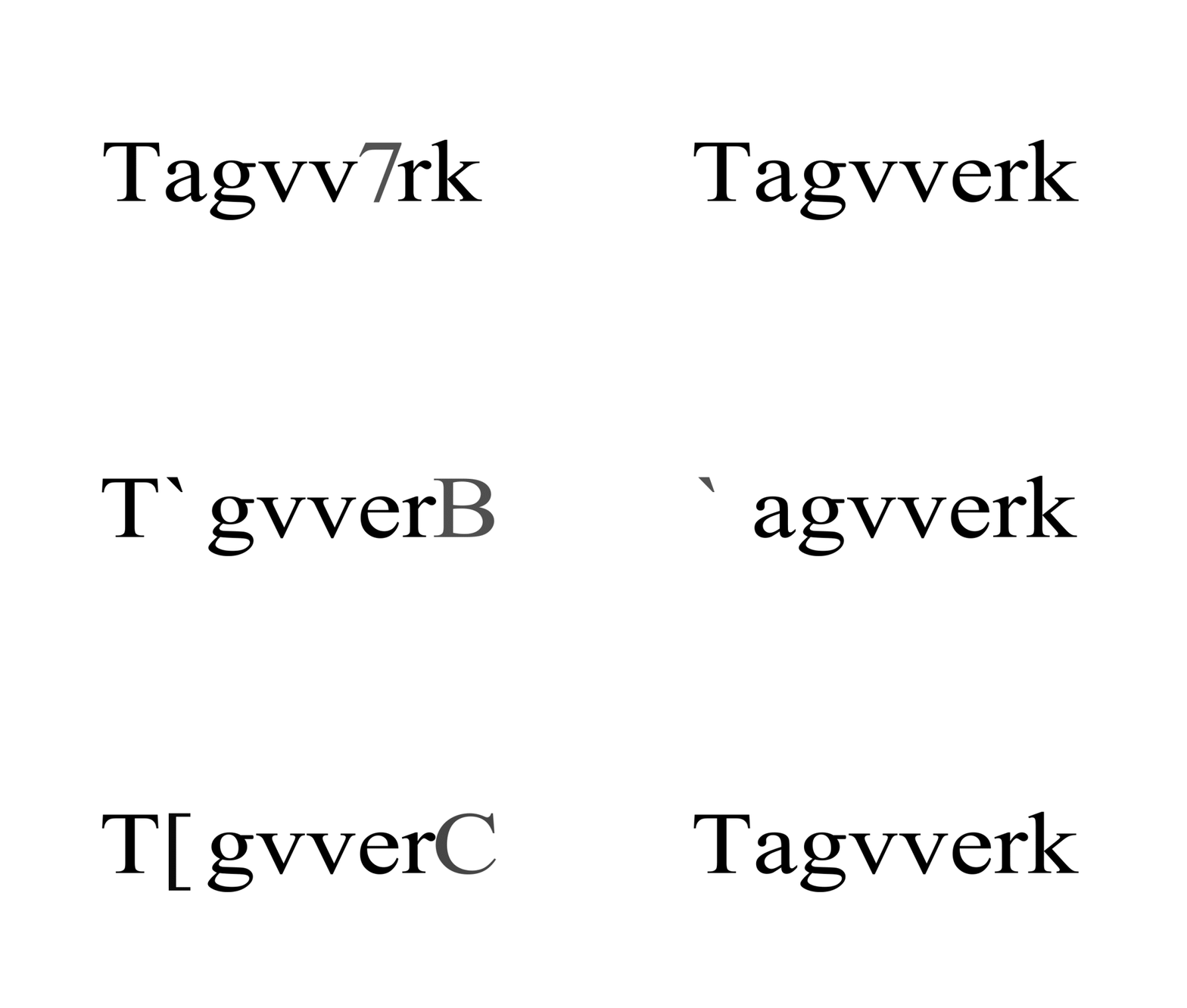
Gabriel Coffman


**

GABRIEL COFFMAN is a PhD Candidate in the University at Buffalo and has been a reader/screener for Fiction Collective 2, Subito Press, and Timber Journal. His work can be found in: Softblow, Yalobusha, Psychopomp, Gone Lawn, Red Ogre, Dream Pop, and elsewhere.

Ben Roylance

from The Horoi Control System

1. At the Plot

A private woodland clearing,
two figures, a
Surveyor and his Client,
some stones and statues,
trees around, dirt and foliage,
just past noon.

Surveyor: professional with tools of trade, dagger, and wounded left eye

Client: a man worried over new laws affecting his property, one robotic hand

Surveyor (ceremonially):

Day’s work like this, I love to
See it right, as light cliffs off
The midday sun above the high
Level, fair to bring it to a level rest,
Tape pulled as taught as firstest vine,
Real left eye wanders cross the right’s line,
Hey, it looks to easy meet the straight
And oldest track to this rightmost virt-
Ue stars elapse thru in siring time’s material,
The work of he who ‘spects the land is
Best performed in talismanic hurt, so say:
I enact again the introduct of Pain’s Pain—

Client:

Again? Hard knife feasting in? In-
To gel of sinister eye? The plain violation
Of the holy orb, why? How? To charge a
Slash across someday’s pipe? Or now?

Surveyor:

Clearer sight thru punctured ‘ball,
Knife charmed, yclept Pain’s Pain,
Charms the survey, cuts open in-
Ner compass rose, draped on pain,
Like a jacket closet-kept ‘til winter
Makes in dream an appearance, in dre-
Am knowing where it hides, behind
A door hid itself inside a mirror,
This blade injects the primal minist-
Rations for the psyche’s closed peeper,
Second ghostly left eye just an atom’s
Breadth ahead of first, untouched
By all the physics of decay or growth,
Our study but a con without pro-
Visions for the waking up that Survey’s
Eye.

Client:

A knife cuts open 2nd sight, like lance
In royal tales of disc tableau,
Grail or saucer to allay the sick?
The day eclipses all but other side
Of such a sword, your night, ‘pon
Which’s coming comes the law
Of bounds, of total stony rule.

Surveyor (friendlily):

The why of getting’s start, to be-
At a nightfall’s new nature: Control
System superposing rock on life,
Roused past dusk the mind com-
Posed of them inscribed and standing,
To say tis better groping to a sense
While day’s on guard than risk, yes,
The coming of the final structure: Horoi.

Client (suddenly grim):

HCS, sociomagicolithical
Reappraisal of the humble bound-
Ary stone, does on this final day
At end begin. Horoi Control System!
100 lunar years’ plans come to night,
And my plot still not in order…

Surveyor:

We’ll with steel tape’s shimmer
Set it right, these dozen and five
Squat standing text-tat’d liths en-
Act their will at dusk’s calculated
Coming, suggesting our seven hours
For filing with the lithauthority a chart—

Client (interrupting):

That new landlord dios which evicts all ten-
Ants at work-colony on his gridded lands,
Not a personage or inarticulable spir-
It, but a System of reactivated so-called
Stones, variously hermae, posts, mono-
Liths, blocks, mortgage stones, fence
Stones, oldenough trees carved, folkrocks,
Termini, absences, stones, quartzes, stony
Gargoylic assemblages, stacks of stones,
Flat iron plate embedded in, a mask,
All coalescing into-as Horoi Control System,
An intelligent noös around the deepthr-
Oaten wild well of wild life on former Earth,
Now soon not so named.

Surveyor:

All aware, as all are warned,
In preparation for new land-
Marking, new make of mornings’ mort-
Gage at institution/activation of the horoi
Various, we’ll seek escape from lot
But find stone bars across all egress,
All having been scolded into sub-tracts,
As here we chat in final hours of agency
Measuring with these tools ancient
A stubborn square whose incalc-
Ubility seeps pressure into your life,
Client.

Client:

Panics approach, as tricks turn
Parcels to crimes, jests of earth,
Some deep-set unearth in earth
There in northeast corner of my
Square, hire uncertified surveyor,
You, whose works I’ve seen in clips,
For sorting this out off the books quick,
And we sharing a sympathy divine
Do to inner faculties plain resort, no
Common perfidy leaks out from ei-
Ther altered state we people: your eye,
My hand, both left both modified
By spirit and by highest artifice…

Surveyor:

As the plural in the System name Horoi imp-
Lies law’s centerless mesh we two as poles, hor-
Os and horos, our own mobile bounds,
Herma to herma, flank a center in dia-
Logue, that core a congregation, the mom-
Ent of the fathering of the next, I keep
It understood, it all kept level, my transit nimble
Like of tomorrow’s ocule all-seeing we whis-
Per good, I say, as true dimensions unspool
Like silk and rough cord through theodolite’s
Cold gaze, an eye for an eye all-seeming,
Which at dark’s threshold begins to look!,
My left eye, skewered such by knife Pain’s P-
Ain, and opening its ghost-eye so to see
All much further clearer your plot’s pecu-
Liar problem, a solitary swollen clod
Up yonder where we’ll hurry now.

Client:

Consult the plat man, notice lack
Of notice given on anomaly, no
Break in evenly uneven land where
Now a bulging pit doth breathe
With wind or thunder, what hints
At subtle buried voice, I love it not!,
Not on my land, that is, let’s uproot
Mandrake or gnome intact therein
So as to get it far from what for which
I’ll be responsible in just some hours’
Time upon the coming of the HCS!

Surveyor:

Calm, client, we’ll dig
And chart again around
This excess or deficiency,
Not too broad a scar up-
On the tract to warrant pan-
Ic, though woods ecology
As here we find can make
A survey less than straight,
And though this odd tossed
Mound might make a fuss
Of our wish for gridding,
The watcher stones yet
Slumber, we’ll sort all out
While deep the so-called
Horoi sleep, defending none.

Client:

Here, we come to it:
Down with your theo-
Dolite, delight to as
You promised dig!
Here, my false hand,
False in that tis more than
Real, robotic hand which
Cuts with claw and cup,
A memory of other life
Might overcome the light
That sets the present up,
Ancient horos birthing up
Nymphe temple boundary
One of thousands same,
But under that, just to
The side, what’s there?

Surveyor (digging, effortful):

The horos in tradition does
Delimit Athenian space, like
Post or rock or fence, like
Here it marks what once where
Else was temple ground, now
Space is bit confused, con-
Fining all in cursing town-
Ships, here is where ano-
Maly perverts the plot, I
Feel bad time wafting up, ap-
Otropaia hum down there…

Client:

Halt there, it’s there,
That which warps this wood,
Uproot that shape, what?

Surveyor (unearthing the object):

Oh? A head… cut clean from her trunk,
All dead, but hush… No, you hear
It speak? You see lips stretch and tongue
Leak lather’d intellect? No?

Client:

No.

Surveyor:

Yes, tale slips in through Pain’s
Pain’s slit, aural-ocular input
In bits antique, I’ll interpret:
“Bells, bell rings, conden-
Satiated hallucinated chimes bell, I
Stuck stray between two instances,
Oh my anticipation of second peal
Which comes but never comes,
Here stood, here stood, my prop-
Itiations, nymphe, masseuse of
Earth, bells, kept in shape, kept her
In shape, mark my space, we
Kept the earth in right form,
Remasturbated and aligned all the
Trees, perpetual fertility pill-
Ars, what work this was, and
Here my only skull interred, how
Sad for me, as all the buried shuf-
Fled are, fly from rightful crypt
To any suburbia, what blo-
Omed from your iteration of
The same thing we worshipped,
Social?, so finally social, had to bat-
Ten it down, was said, nine fingers
On to eight, to seven, left the boun-
Dary stones and not much else o-
Ver aft’r, this head won’t rot, but ch-
Ange, lopped off of me, angel- nymph,
Sexless and so encompassing all
Sex, young as having not
Been born except as eternity
Births presents in a tracking flow,
Ancient and so maiden-crone,
The sanctity of brothel-math era-
Sing songs of sorrow, songs of joy,
Ghosts do so sing, hush and enter ecto-
Parlor boys, here, enter…” ack,
She’s left, the head is mute…

Client (with concern):

Around thine dagger’d eye,
Blood where once was cleanest
Entry, does Pain’s Pain cause same,
Pain? I thought as you spake out
I heard a tonal shiver, so feminine,
But pitched high and higher, cut
Out, then blood bled out, dizzy?
Come, we’ll set down here at
Fallen pine, we’ve worked the
Problem into sense, let rest
That grisly head— oh, it?

Surveyor:

Tricky! It’s nymph no longer, but
A species of silver skull? What’s this all?
As bald and mineral as trench it
Exited, silent ore, ah, it’s out now
At last and least, I’ll steady again
And work my tools to straighten
This tract con horas to spare ‘fore
Horoi crack their flinty ojos at us…
Here, hold this, the land now will chart.

Client (dazed, skull in hand):

Do you hear it not? Unna-
Tural voice rings in my hand,
Echoes up the arm to ear,
It sparks, it speaks, pron-
Ouncements of a great mac-
Hine, what clipped the fruit
From future’s final first tree: help!
It speaks through me to me and
You, survey-lancer: “Oh TDH 51-17
Mechanical hand attached to hum-
An arm! How sunny a channel
You open for me, the coming man,
First dead, concomitantly buri-
Ed with a nymph, now share
A skull, can catch confusion’s dou-
Bling shimmer down in here in 2-
As-1, but TDH 51-17, and who-
Mever man you serve, hello,
Long ahead when I can see you
Again, crushing the cosmic egg
Between bludgeon-fingers miles
Thick, I see you now at horos-edge,
Seder-sorting out the well-hole we
Slack’d in, grave of was and will,
Pair of discorps in dissonance, what
Makes for harmony anyway, what
Comes to be, Design!, design,
As microboundaries mutate
The scope and angle of man, just h-
Ours now, all property, all seen,
Mechanical hand, usurp your
Canvas, theodolite and tape,
Witch’d knife, overthrow your
Man, comes soon the strict net! – “

Surveyor (snatching the skull):

I hate its music! Mete your mea-
Surer, head, and back in a ditch with
You! My dagger-sheathing eye sees
A planted oracle when it sees, a trick
Of pending HCS, we’ll waste not an-
Other minute—”

Client:

Hold off, there’s nothing
Left, the cranium is vapor,
Is this serious? Or a hoax?
Landmeater, what in your
Art might wipe this foggy
Mirr’r clean? Nymphe, to
Metal-electrical skull, how
Cougheth up a plot this object
So indeterminate? Absent here.

Surveyor:

Absent now. I’ll…
I’ll adjust the plat, gem it
Well for high geolicarchon, slick it
With the thickest gel of craft, we’ll…
We’ve got the property enume-
Rated, no computer’d think
Once or twice of its veracities,
No horos or herma’d que-
Stion the placement of a single
Stem, post, stalk, or fertility
Glyph on your land. Fill
The hole and I’ll seal the map.

Client (aside, filling excavation pit):

All land is scene. Long bones
Cross the fields and wait for Horoi
Night when bounds comb a-
Cross what wields a standing man,
A horos is a nickéd tree just o-
Ver property line, a heap, a
Mound, classically an inscri-
Ption-bearing hunk of ston, yes,
But HCS generalizes, spans all
Borders, wars, and private places
Now, control encompassing, no
Private spaces when the nodes
Of antique boundary grow eyes
For careful integration of duration
And extent, all rather roughly done,
Sudden etched into the social man-
Dala, data and force, and care and
Justice, not blind but all seeing as
Chiseled into rock unblinking,
Amoral Hermae and Termini den-
Oting lines unseen now invisibly
Imagino-electrified for souls’ con-
Course, and I here in my hum-
Blest family tract of woods procr-
Astinated on by a mystery’s head,
I flex my artifice, crack its joints…

Surveyor:

Behind you, friend, behind,
I’ll not start you out of self-
Conferring, but note: I’ve
Living yet codified your plot,
And in time for a brief lunch,
Pain’s Pain at last unsheathed
From eye, survey now conc-
Luded, that nymph-cum-skull
A vapor now, may be had been
But telluric prank in total –

Client (interrupting):

No geo-jester’s puckish

Play was that oddity, sur-
Veyor, a veil of tempo-space
For we each was torn aside,
Whatever contact came
Came in same reality as HCS
And our business here, I
In my submental mech-
Hand unmind feel a lonely shift,
A melty mirror over day,
A slate marked up with all
To emanate from yet,
Ah, geodet, can’t chart this?
Can’t survey my thought?

Surveyor:

I have fastened a bolt.
And see: humble effigy I’ve
Shaped from oak with Pain’s Pain’s
Sharper edge, now set above the
Pit whence that shifty visage
Spewed, subsumed soon,
I know, into the net of nod-
Ules, but this homunc will
Disobey, follow old cadastral
Code, a kind of old magician’s
Law, not a double but a single
Agent, apotropaic gnome, a trick
Of my own against the ‘merging
Control System on your behalf…

Client:

And why? to tempt the forces?
Knower of the bounds is bound
To test them? Fine, we’ll soon
Final parcel off this land for do-
Nation and a tax-incentive under
‘Morrow’s governor, a cursed
Tablet-figure left as spoof is but
A drop of water in not-water’s sea.

Surveyor:

You heard and spoke
An android skull’s forecast, I
The forlorn and olden wis-
Dom of a sacred nymph,
Both out of time and place,
Both speaking of the boiling pot-
Ency of a horos stone. Nerv-
Ous laughs echo round the
Global village as approaches
Limit of a former way, a route
Surveyed and deflected through cent-
Ral-dispersed pseudintelligence,
Who knew it who waited for …
Hey, here, a brutalized dummy
To deceive and keep away archon,
My hobby a superstitious techne,
But come, let’s retire, land in or-
Der, counterprank pulled, angels app-
Eased, I’ll hope, and see you grin,
Neck grows stiff from labor now,
I’ll accept my pay’s latter installm-
Ent over finest coffee, ….
We went (?).

Client (slowly):

We did go, left my land,
But some now of us stayed.

Surveyor (surprised, slowly):

It’s the time all at once.
Mind, my doll has snapped
Apart, sky grown hideous
With this unfriendly advent,
Into which pit did our hours
Siphon? Unearthed again?
A feigning human head!

Client (plainly):

Wake. You’re seeing the thing
From thy puppet’s working,
Exfoliates the earth’s spirits, let’s go,
It’s really not yet time, but a trick
You’ve pulled on you with wild
Magic, here, this way to patch’s exit.

Surveyor:

A hijacked trance.
HCS reroutes counter-
Surveillance. Bad om-
En moment.

Client (leading Surveyor uphill through woods path):

Though through illusions’ shrill protest,
The job scratched out is done. The land
Is known as known we’ll get it. He-
Re, the sun lower now, from this vant-
Age, up a modest hill away, my plot
Looks just about as how you’ve mapt,
Bounds crisp, ready for Horoi System’s
Strictest eyes. No memory kept need be
Of that vision shared…Exit with me.

Surveyor arrives with Client at the latter’s home
a short distance from the surveyed land.
Approaching dusk.
Client offers coffee
and steers conversation toward a lecture.

End: 1. At the Plot


**

BEN ROYLANCE operates Apport Used Books. He is the author of A Talking Skull (the holon project, 2022, audio edition from Peace Isn’t Luck, 2021) and AQ Saga: Neuro-Piratical Self Help in Pocket Universe 17! (forthcoming from Hiding Press).